8 Month Old Wake Windows: 2h 30m to 4h 30m + Schedule
Oleh Onysko October 16, 2026 11 min read
Nap times for your 8 month old, worked out from their wake-up time.
Get my nap plan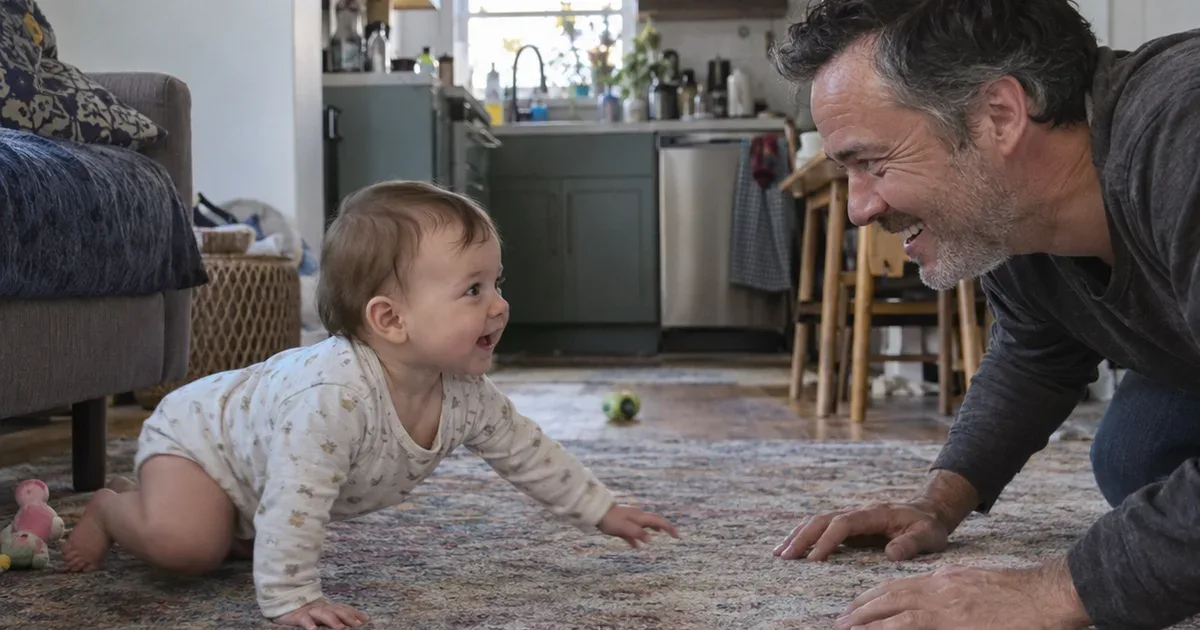
In this article
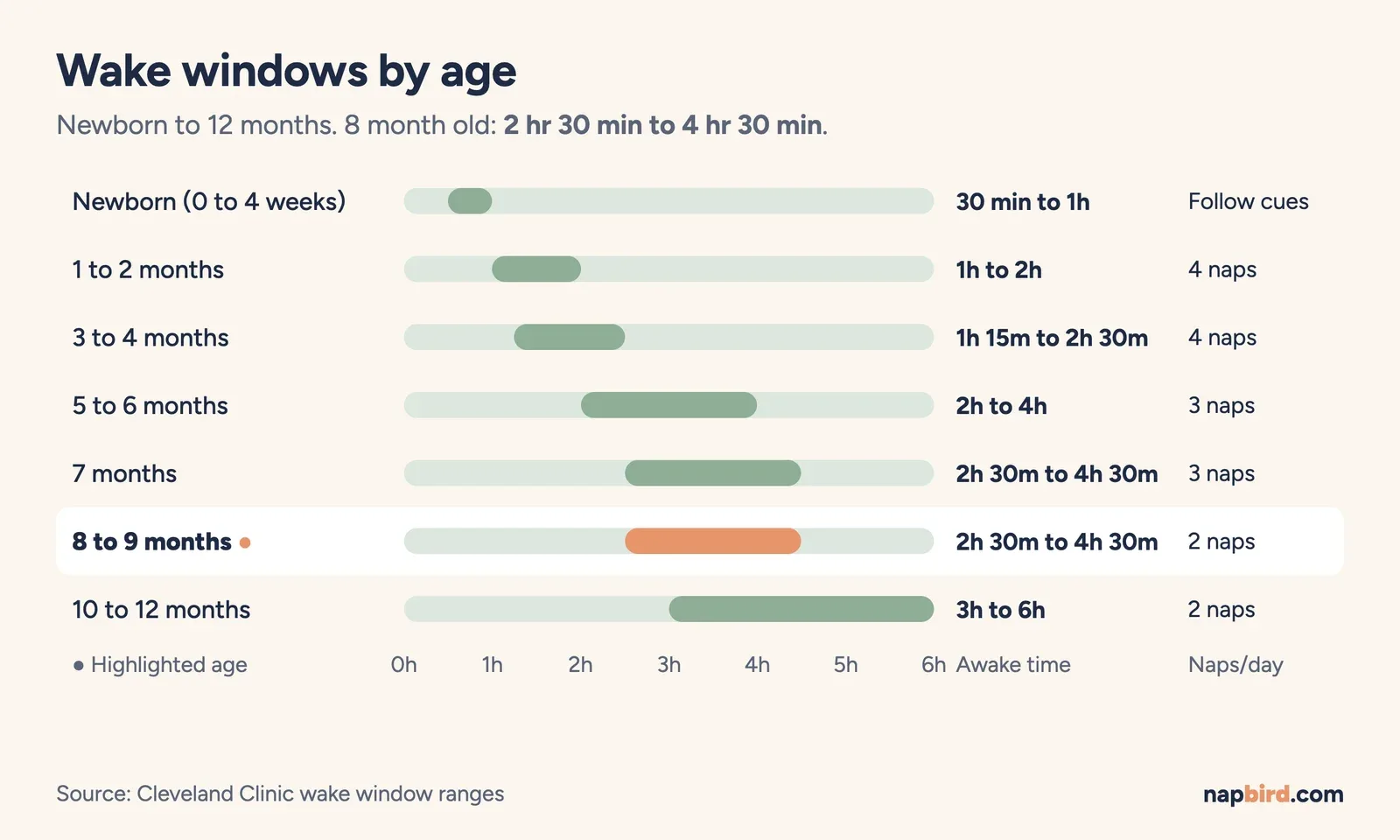
8 month old wake windows are 2 hr 30 min to 4 hr 30 min. Most babies this age fill that stretch with crawling, a meal or milk feed, a change and a slow lead-in to one of two daily naps.
Here is the part most parents have backwards: when an 8 month old cries as you leave the room at nap time, the window is usually not the problem. Separation feelings tend to show up right at the handover into sleep, so a protest can look like "not tired yet" when your baby is tired and simply wants you close. Stretching the window to wait it out often leaves you with an overtired baby who still wants you. Add connection to the wind-down first, and only move the timing if the pattern holds across several days.
| 8 month old at a glance | |
|---|---|
| Wake window | 2 hr 30 min to 4 hr 30 min (Cleveland Clinic) |
| Naps per day | 2 |
| Usual nap length | About 60 min |
| Total sleep in 24 h | 12 to 16 hours, naps included |
| Sample bedtime (7:00 am wake) | 7:00 pm |
8 month old nap calculator
Wake window calculator · dates stay in your browser
Free · No account needed
8 month old example · 7:00 am wake-up
8 months · 2 hr 30 min to 4 hr 30 min awake
Wake
7:00 am
Nap 1
10:05 to 11:05 am
About 60 min
Nap 2
2:25 to 3:25 pm
About 60 min
Bedtime
7:00 to 7:15 pm
Example nap lengths adjust within 30-120 min to fit the day. Wake ranges: Cleveland Clinic.
Get my nap planSample 8 month old schedule (7:00 am wake-up)
This is the day the free calculator builds for an 8 month old who wakes at 7:00 am and takes two naps of about an hour. Notice how each awake stretch is a little longer than the one before it.
| Time | What | Awake before it |
|---|---|---|
| 7:00 am | Wake up | Start of day |
| 10:05 am | Nap 1 (about 60 min) | 3 hr 5 min awake |
| 2:25 pm | Nap 2 (about 60 min) | 3 hr 20 min awake |
| 7:00 pm | Bedtime | 3 hr 35 min awake |
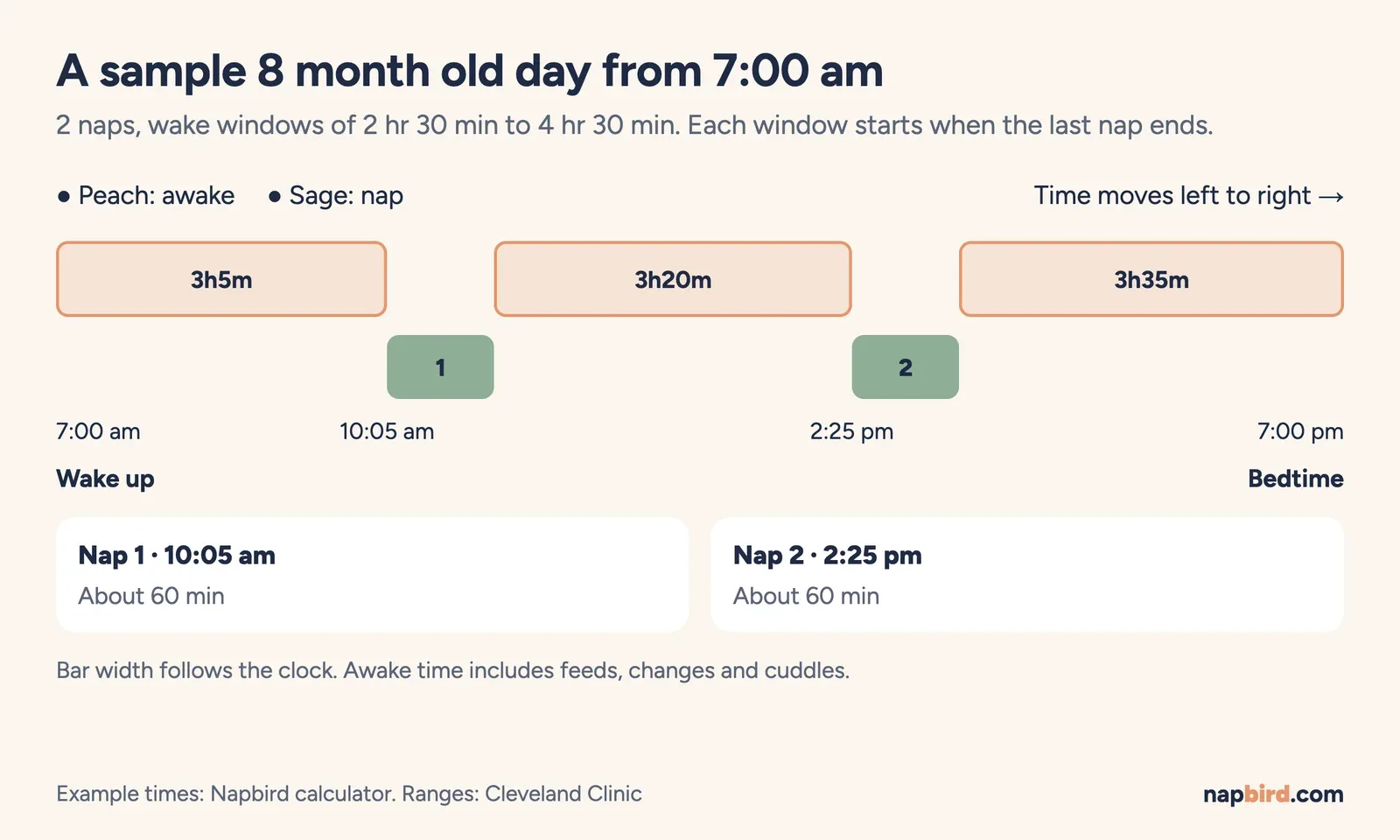
Treat these times as a first draft, not a timetable. If your baby woke earlier, the whole day slides earlier, so count from the wake that really happened. All three stretches sit inside the range in Cleveland Clinic's wake windows by age, well below its upper end.
How many naps does an 8 month old need?
Most 8 month olds do well on 2 naps a day: one in the morning and one in the afternoon. For many families this is the first month of a two-nap rhythm, after the three short naps of the months before. Those two naps plus the night add up to part of the 12 to 16 hours in 24 that the AASM pediatric sleep consensus recommends for babies this age.
Two naps give the day two anchors. Put the energetic floor play early in each window, then leave room for a feed, a change and a calmer few minutes before sleep. The afternoon nap matters most for the evening: when it ends early, look for tiredness sooner; when it ends late, bedtime may drift later too.
What does a good awake stretch look like at 8 months?
A good stretch has a lively middle and a quiet end. At this age that lively middle is often crawling, whether that is a proper hands-and-knees crawl, a scoot or a determined belly slide toward whatever you just put down.

Give movement the floor while your baby is fresh, with you close by. Outings fit here too: before you leave, note when your baby woke and think about where the next nap will happen. When you get home, take a few minutes to reconnect before you aim for sleep, because a busy room full of people can leave an 8 month old wired and clingy at the same time.
8 month old sleepy cues: early and late
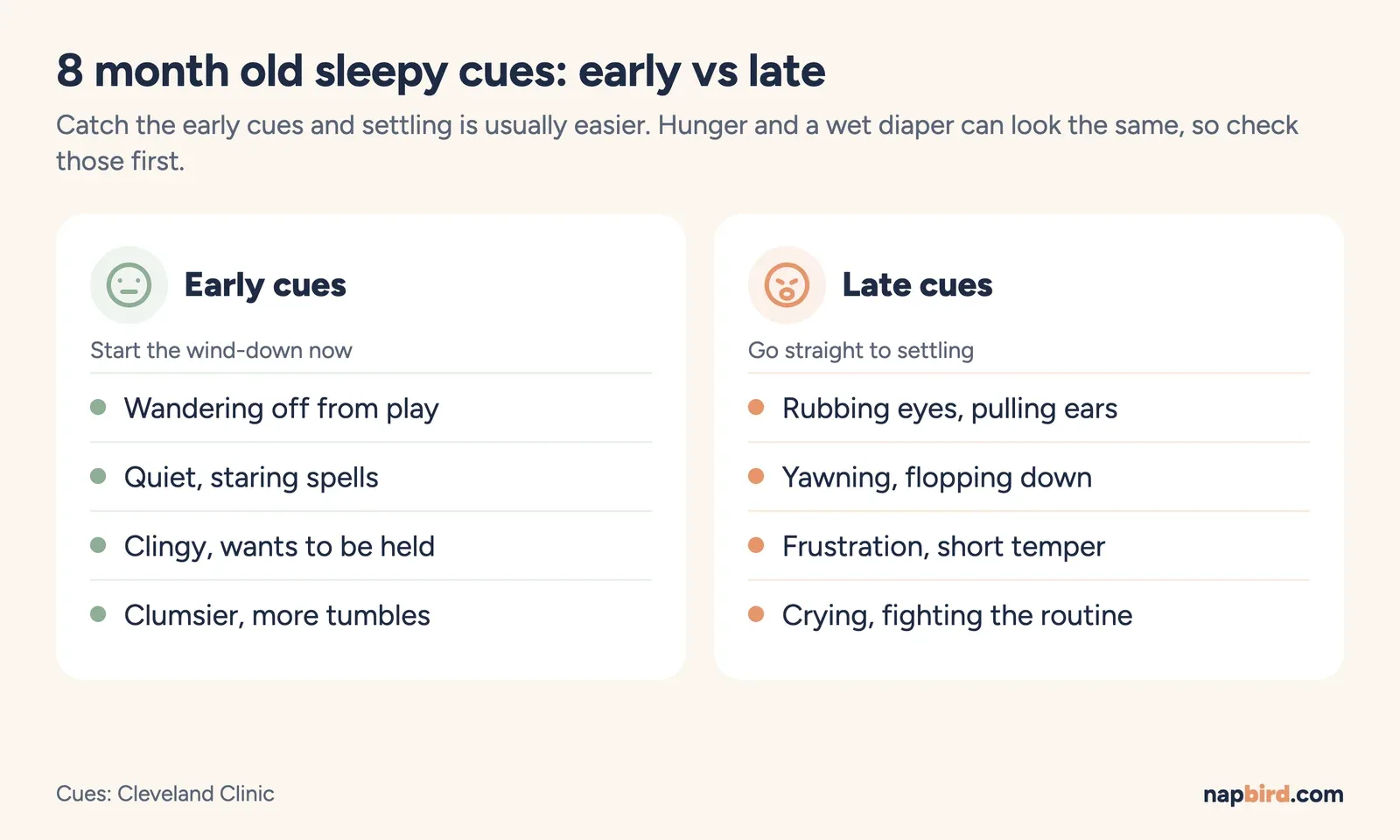
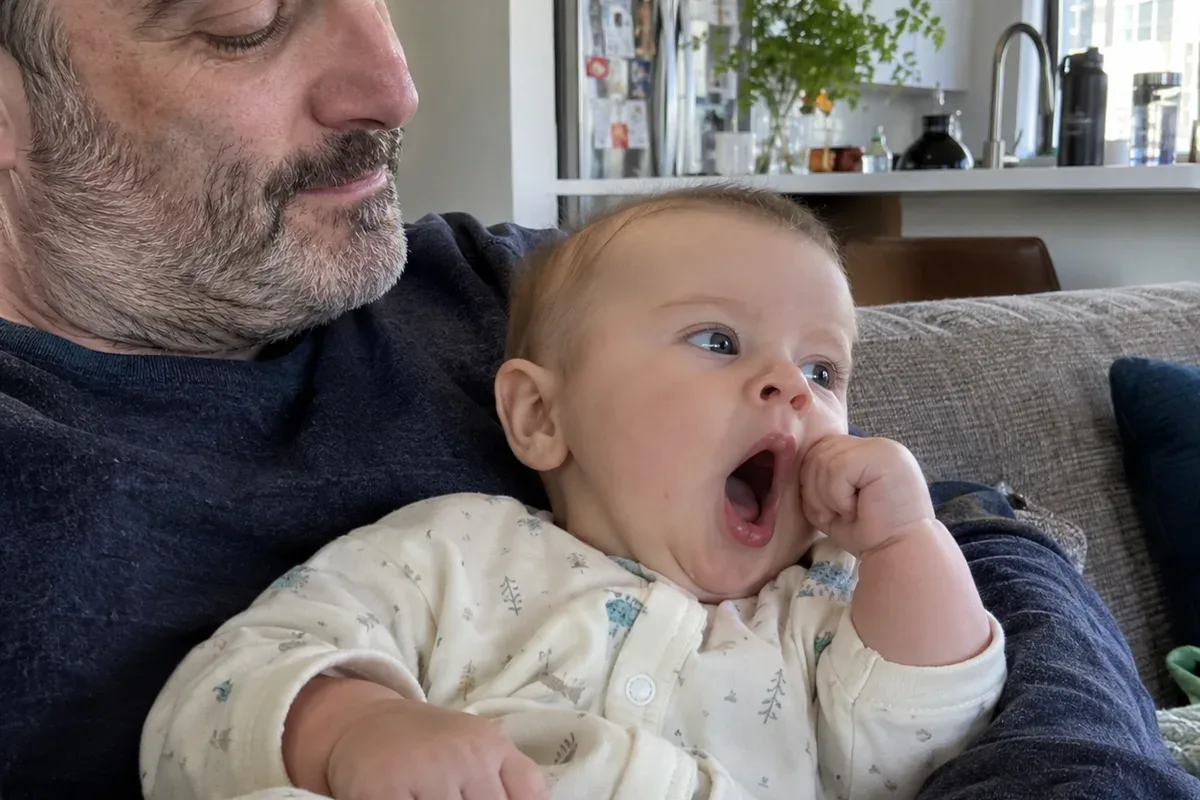
Early cues at 8 months are quiet: a stare into the middle distance, a yawn, a sudden loss of interest in the toy they were chasing. Late cues are louder: frustration, arching, crying when you step away.
| Early cue | What to do |
|---|---|
| Yawning or looking away | Lower the noise and start the wind-down |
| Staring between bursts of crawling | Swap floor play for a book on your lap |
| Rubbing eyes | Offer a feed if due, then head to the dim room |
| Fussing at a favorite toy | Pick your baby up and slow everything down |
How to use 8 month old wake windows
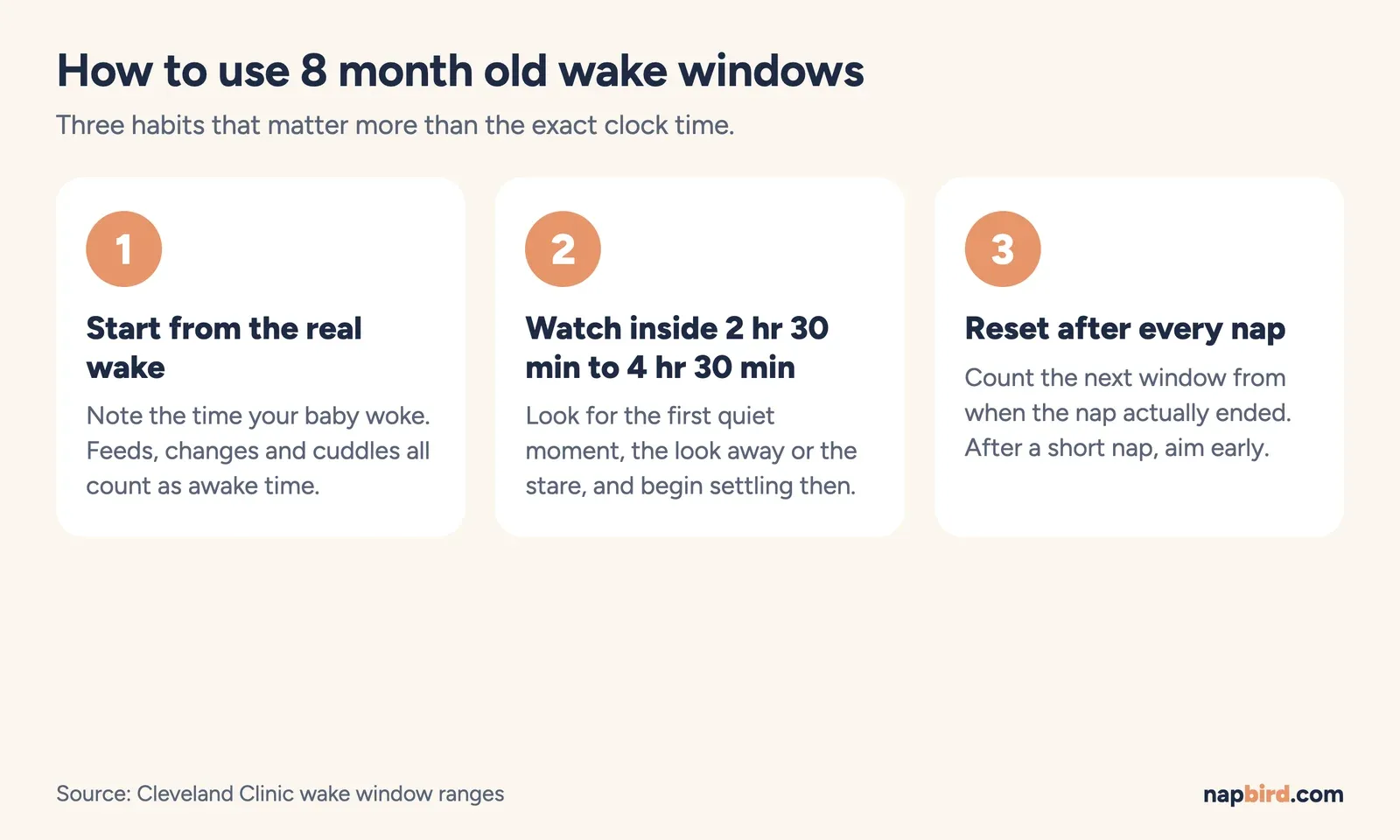
- Start from the real wake
Write down the time your baby actually opened their eyes for the day. Feeds, changes and cuddles all count as awake time.
- Watch for the quiet moment inside 2 hr 30 min to 4 hr 30 min
Once you are inside the range, look for the first stare or yawn. That quiet moment is a better signal than the exact minute.
- Count the next window from the nap that actually happened
The next stretch starts when your baby wakes from the nap, not when the nap was planned. After a short nap, aim for the earlier part of the range.
- Wind down before fussing builds
Begin the routine at the first early cue. A clingy 8 month old settles more easily when the goodbye is calm and unhurried.
What if the day goes off plan?
Most off days at 8 months come down to one nap that ran short, ran long or never happened. Find your situation below.
| Situation | What to try for the next window |
|---|---|
| Short nap under 30 min | Offer the next sleep toward the start of 2 hr 30 min to 4 hr 30 min |
| Long nap | Count from the late wake; bedtime may move a little later |
| Early morning wake | Start the clock from that wake and watch for cues sooner |
| Skipped nap | Keep the second nap on offer and plan a calmer, earlier evening |
| Born 3+ weeks early | Use adjusted age, which may point you to the 7 month guide |
| Sick or teething day | Follow cues over the clock and offer extra comfort |
A skipped nap is not a sign your baby is ready for one nap. Offer both naps again tomorrow and look at the pattern over a week, not a single afternoon.
On sick days the clock matters less than comfort. Let your baby rest when they need to, keep feeds responsive, and go back to the usual rhythm once they are feeling like themselves.
A wind-down that works at 8 months
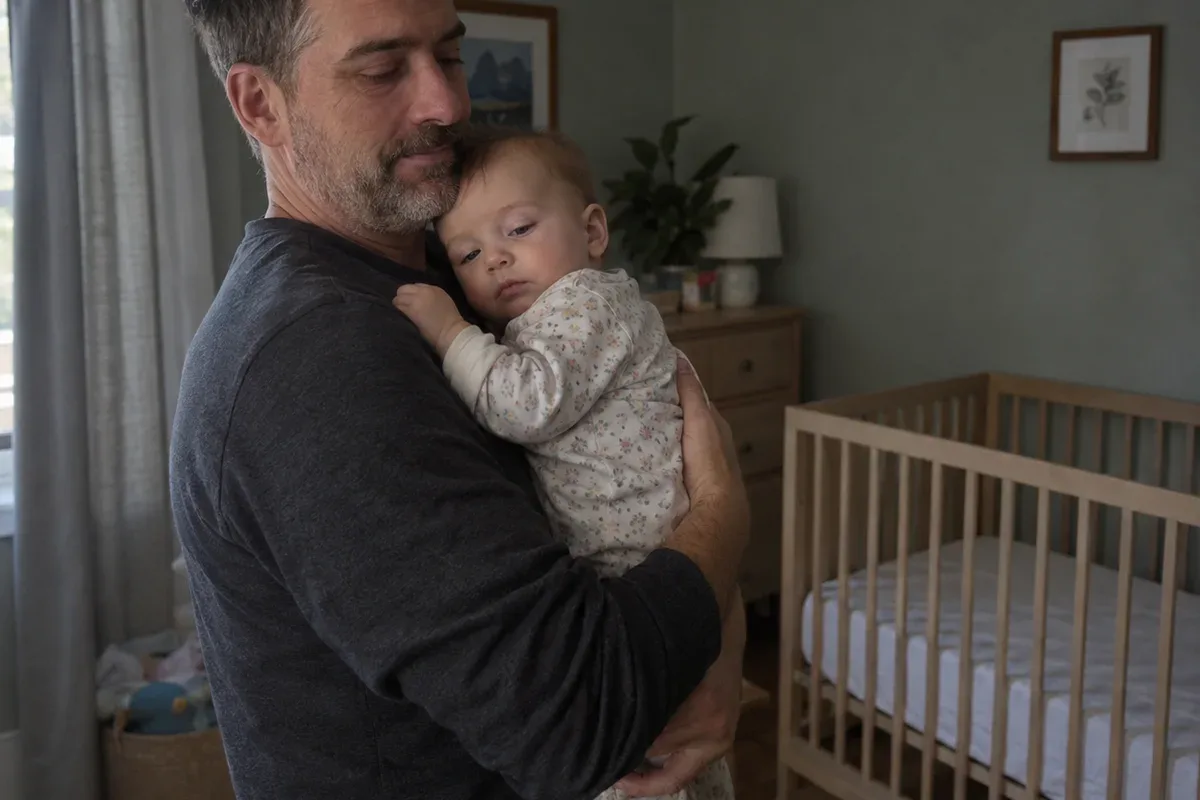
An 8 month old notices when you leave, so the best wind-down at this age is short, the same every time and ends with a goodbye your baby recognizes.
- Close the curtains and lower your voice.
- Change the diaper and offer a feed if one is due.
- Read one short book or sing the same song.
- Say the same goodnight words, lay your baby down and leave calmly.
If someone else does nap time, teach them the same words and order. A familiar sequence helps your baby know what comes next, whoever is holding them.
Common 8 month old wake window mistakes
- Reading separation tears as "not tired." Add a cuddle and a familiar goodbye before you add awake time.
- Saving the big crawl session for right before the nap. Move active play to the middle of the window.
- Counting from the planned nap time. Count from when your baby really woke up.
- Dropping to one nap after a single refusal. Keep offering both naps and judge the pattern over several days.
- Using the longest number every time. The range is a span to watch inside, not a target to hit.
Why a chart stops working (and what to do instead)
A chart gives you 2 hr 30 min to 4 hr 30 min, which is a two-hour spread. Your baby changes week to week, one short nap reshuffles the whole afternoon, and 3am is no time to be adding up minutes on your fingers.
The free calculator above recalculates the day from today's real wake time and nap lengths. A nap plan then adapts that day as your baby's sleep changes.
What changes next: 8 months to 9 months
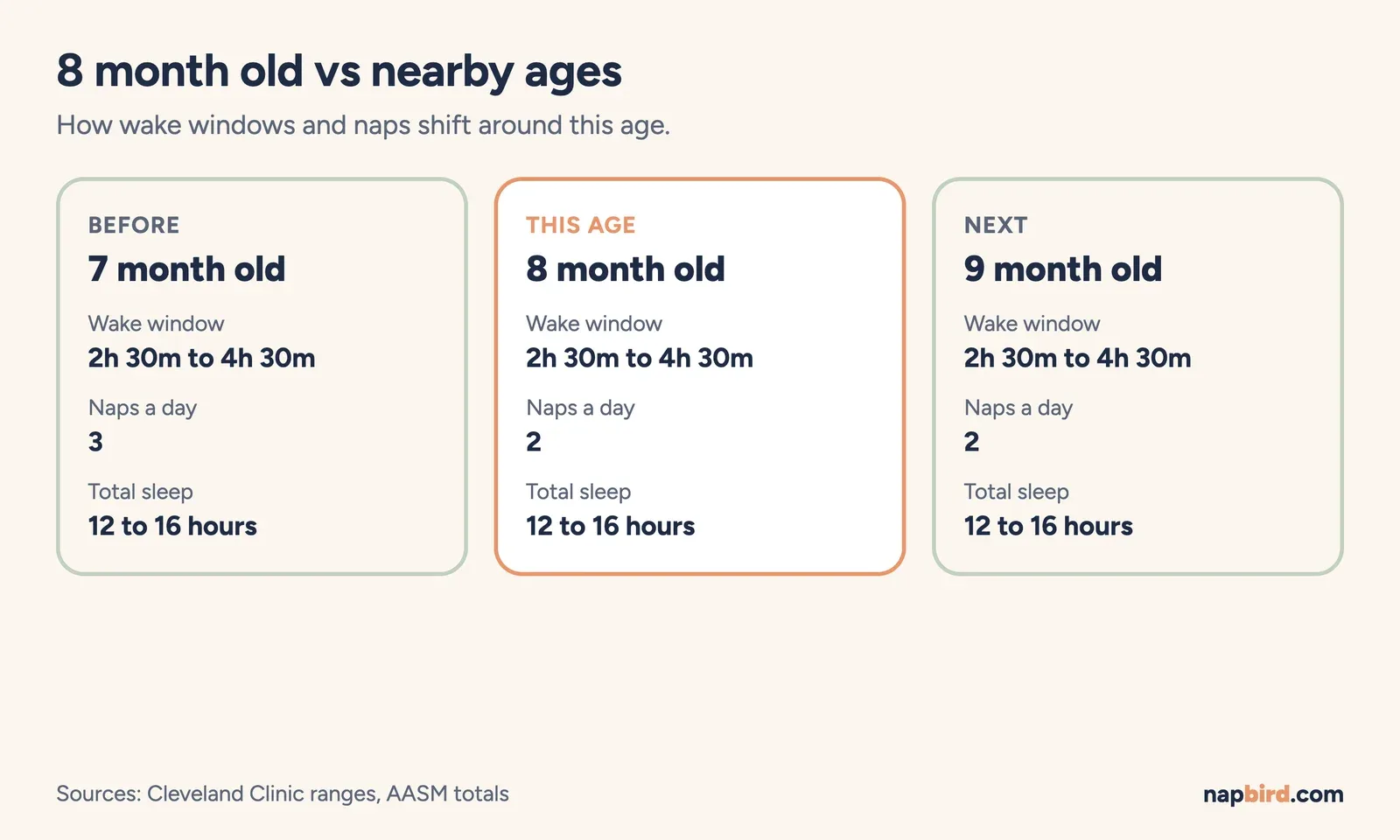
The range stays the same at 9 months, and so does the two-nap rhythm. What often shifts is how much your baby wants to practice pulling up and how strongly they react to goodbyes.
If two naps still feel new, the 7 month old wake windows guide covers the three-nap stage just behind you. Looking ahead, 9 month old wake windows keeps the same numbers and adds more on standing practice, and the guide to 10 month old wake windows shows where the range widens. For every age on one page, see the wake window chart or keep a printable wake window chart on the fridge.
How do I keep 8 month old naps safe?
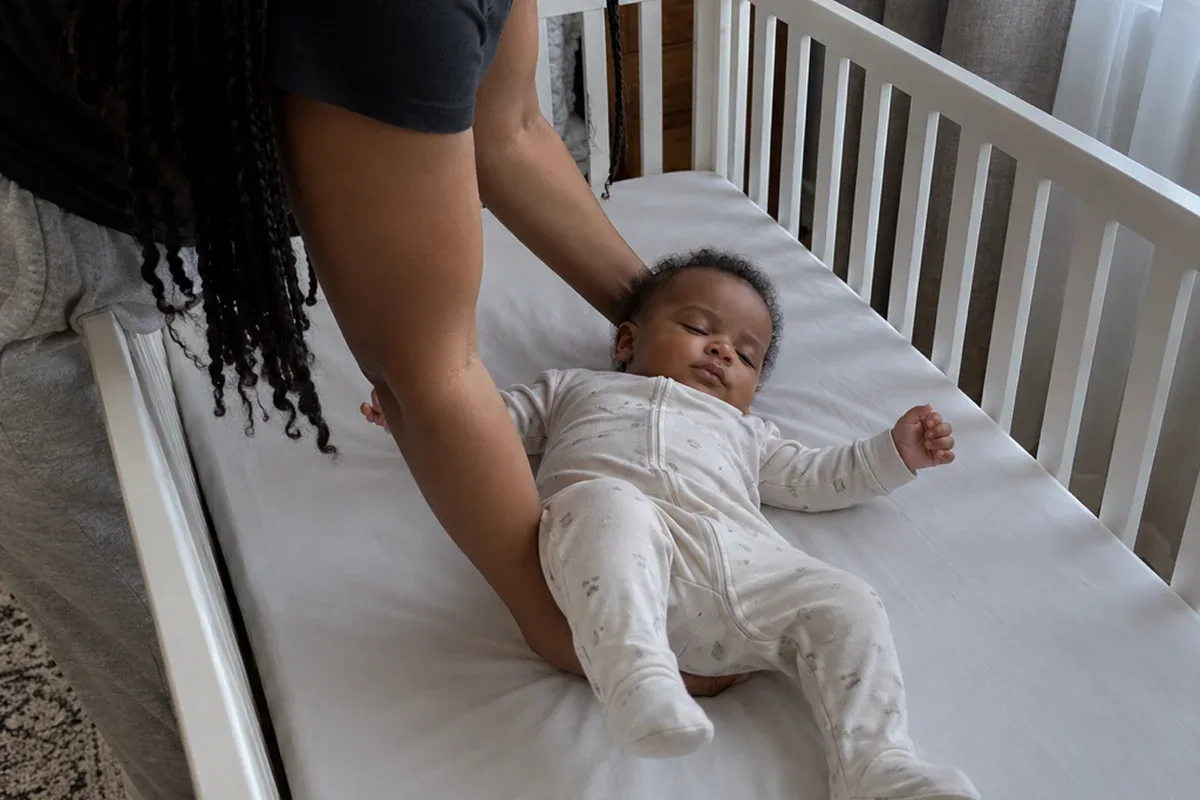
Every nap goes on the back, alone, in an empty crib with a firm flat mattress, even now that your baby can roll and crawl.
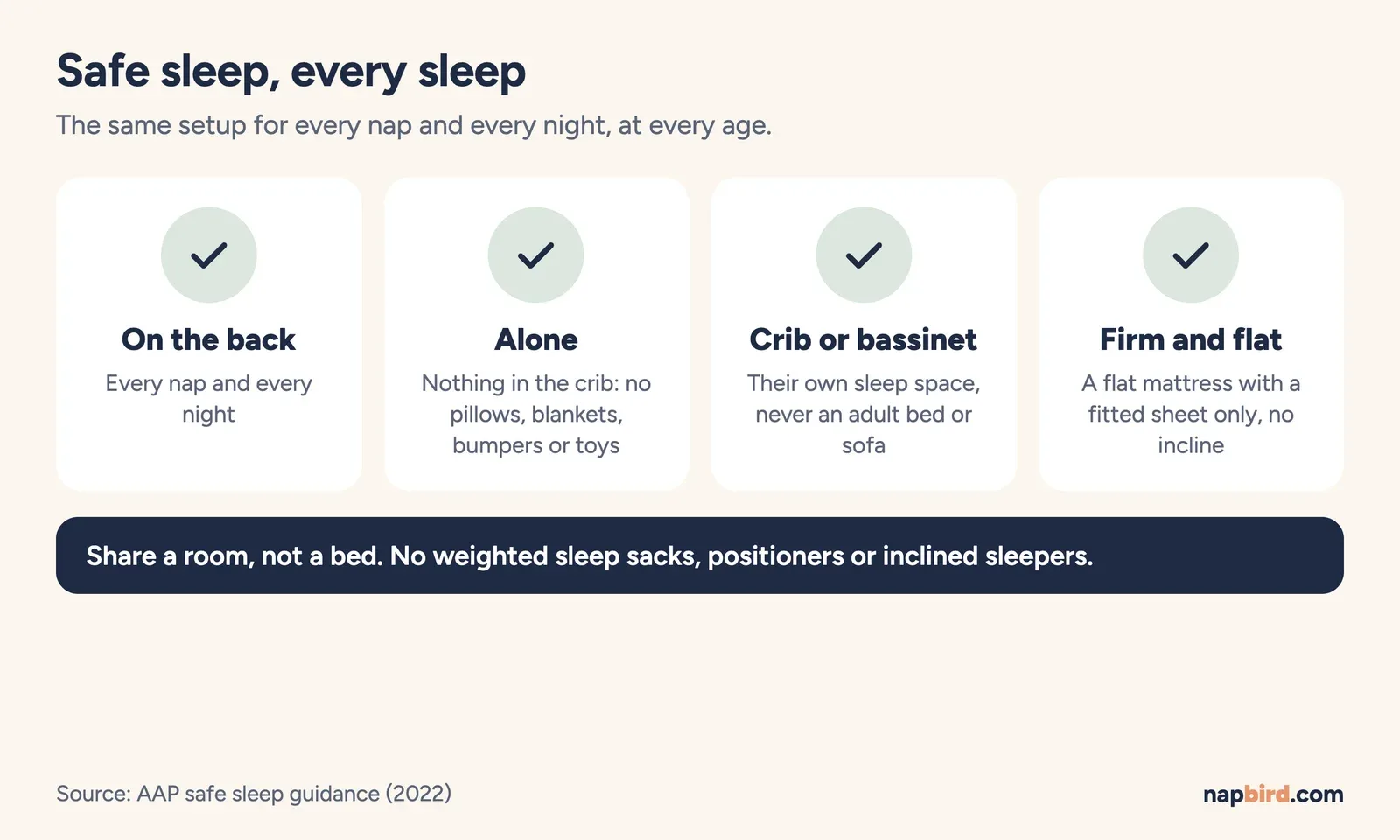
The American Academy of Pediatrics safe sleep guidance comes down to four habits:
- Place your baby on their back for every sleep.
- Keep the crib empty: fitted sheet only, no pillows, blankets, bumpers or toys.
- Use a firm, flat mattress in a crib or bassinet, never a sofa, adult bed or inclined seat.
- Share a room with your baby, not a bed.
For fever, pauses in breathing, blue or gray lips, difficulty waking, or unusual sleepiness with poor feeding, call your pediatrician, or emergency services if it feels urgent.
A guide, not medical advice.
8 month old wake windows run 2 hr 30 min to 4 hr 30 min, across two naps. The habit that matters most is counting from the real wake and meeting goodbye tears with connection before you change the clock. Try the calculator above for today, or get a nap plan that adjusts as your baby does.
Frequently asked questions
Cleveland Clinic lists 2 hr 30 min to 4 hr 30 min for this age. The first stretch of the day is usually the shortest and the one before bed the longest.
Yes, it often shows up right at the handover into sleep, even when the timing has not changed. Keep the wind-down familiar, offer a calm goodbye and check hunger, comfort and illness before blaming separation alone.
Give movement lots of room during awake play with you nearby, including practice getting back down. At nap time, keep the room calm and go back to the routine your baby knows.
Usually not. Count from the real end of the nap and offer the next sleep toward the start of the range if your baby seems tired.
One refused nap is not enough to decide. Keep offering both naps and look at the pattern across several days, including how the evening goes.
A common starting point is a morning nap about 3 hours after waking and an afternoon nap about 3 hours after that, each about an hour long. Adjust from the real wake times, not the sample clock.
Share article
About the author
Founder and editor
Oleh Onysko founded Napbird and builds the wake window calculator. He edits every guide against the pediatric sources cited on each page. He is not a doctor or a sleep consultant, so Napbird is a guide, not medical advice.
More baby sleep guides
Wake windows & schedules · 10 min
10 Month Old Wake Windows: 3 to 6 Hours + Sample Day
10 month old wake windows widen to 3 to 6 hours, yet the sample two-nap day stays close to 3 hours per stretch. Here is how to use the wider range without overtiring a cruising baby, plus cues, a wind-down and safe sleep basics.

Wake windows & schedules · 10 min
11 Month Old Wake Windows: 3 to 6 Hours + 2 Nap Schedule
11 month old wake windows are 3 to 6 hours, usually with two naps. The last window before bed is the longest, so bedtime trouble often starts with when the afternoon nap ended. Sample day, cues, daycare tips and safe sleep inside.
Wake windows & schedules · 10 min
12 Month Old Wake Windows: 3 to 6 Hours + Nap Guide
12 month old wake windows are 3 to 6 hours, and most first birthdays still come with two naps. The total sleep guidance changes at one year; the nap count does not have to. A cue-led day, sleepy cues and signs of the slow move toward one nap.

Wake windows & schedules · 11 min
1 Month Old Wake Windows: 1 to 2 Hours + Sample Day
1 month old wake windows are 1 to 2 hours, and the first window of the morning is usually the shortest one. See a sample 4 nap day from 7:00 am, the early sleepy cues and what to do when the day goes off plan.
Wake windows & schedules · 11 min
2 Month Old Wake Windows: 1 to 2 Hours + Nap Schedule
2 month old wake windows are 1 to 2 hours, and a smiling, chatty baby can still be at the end of one. See a sample 4 nap day, the sleepy cues that show up mid play and what to do when naps run short.

Wake windows & schedules · 12 min
3 Month Old Wake Windows: 1h 15m to 2h 30m + 4 Nap Day
3 month old wake windows run 1 hr 15 min to 2 hr 30 min, and the clock starts at the wake, not after the feed. Here is the 4 nap sample day, the early cues to watch and what to do when a nap runs short.