Bedtime Routine for a 3 Month Old: 5 Steps, 20 to 30 Minutes
Alex Novak October 18, 2026 12 min read
Nap times for your 3 month old, worked out from their wake-up time.
Get my nap plan
In this article
A bedtime routine for a 3 month old is 4 or 5 calm steps in the same order every night, about 20 to 30 minutes long, ending with your baby on their back in the crib, drowsy but awake. Start it about half an hour before you want them asleep, so the routine fills the last part of the wake window instead of running past it.
The part most parents have backwards: the routine is not what makes a 3 month old sleepy. The wake window does that. The routine is a signal, and a signal works through repetition, not length. A 15 minute routine done the same way every night beats a 45 minute one with a different order each time, and a long routine that starts late can carry a tired baby straight past the moment they were ready.
| 3 month old bedtime at a glance | |
|---|---|
| Routine length | About 20 to 30 minutes |
| Steps | 4 or 5, same order every night |
| Last wake window | Up to about 2 hr 30 min (Cleveland Clinic) |
| Sample bedtime (7:00 am wake, 4 naps) | 7:10 pm |
| Start the routine | About 6:40 pm for a 7:10 pm bedtime |
| Total sleep target | No AASM target under 4 months (AASM) |
| Where they sleep | On the back, alone, in a bare crib or bassinet (AAP) |
3 month old nap calculator
Wake window calculator · dates stay in your browser
Free · No account needed
3 month old example · 7:00 am wake-up
3 months · 1 hr 15 min to 2 hr 30 min awake
Wake
7:00 am
Nap 1
8:20 to 9:05 am
About 45 min
Nap 2
10:40 to 11:25 am
About 45 min
Nap 3
1:15 to 2:00 pm
About 45 min
Nap 4
4:05 to 4:50 pm
About 45 min
Bedtime
7:10 to 7:20 pm
Example nap lengths adjust within 30-120 min to fit the day. Wake ranges: Cleveland Clinic.
Get my nap planWhat should a 3 month old bedtime routine include?
A 3 month old bedtime routine needs four things: something that changes the setting (a bath or a wipe down), getting ready for bed (diaper, pajamas, sleep sack), a feed, and one quiet closing cue like a song or a short book. Then into the crib, on the back.
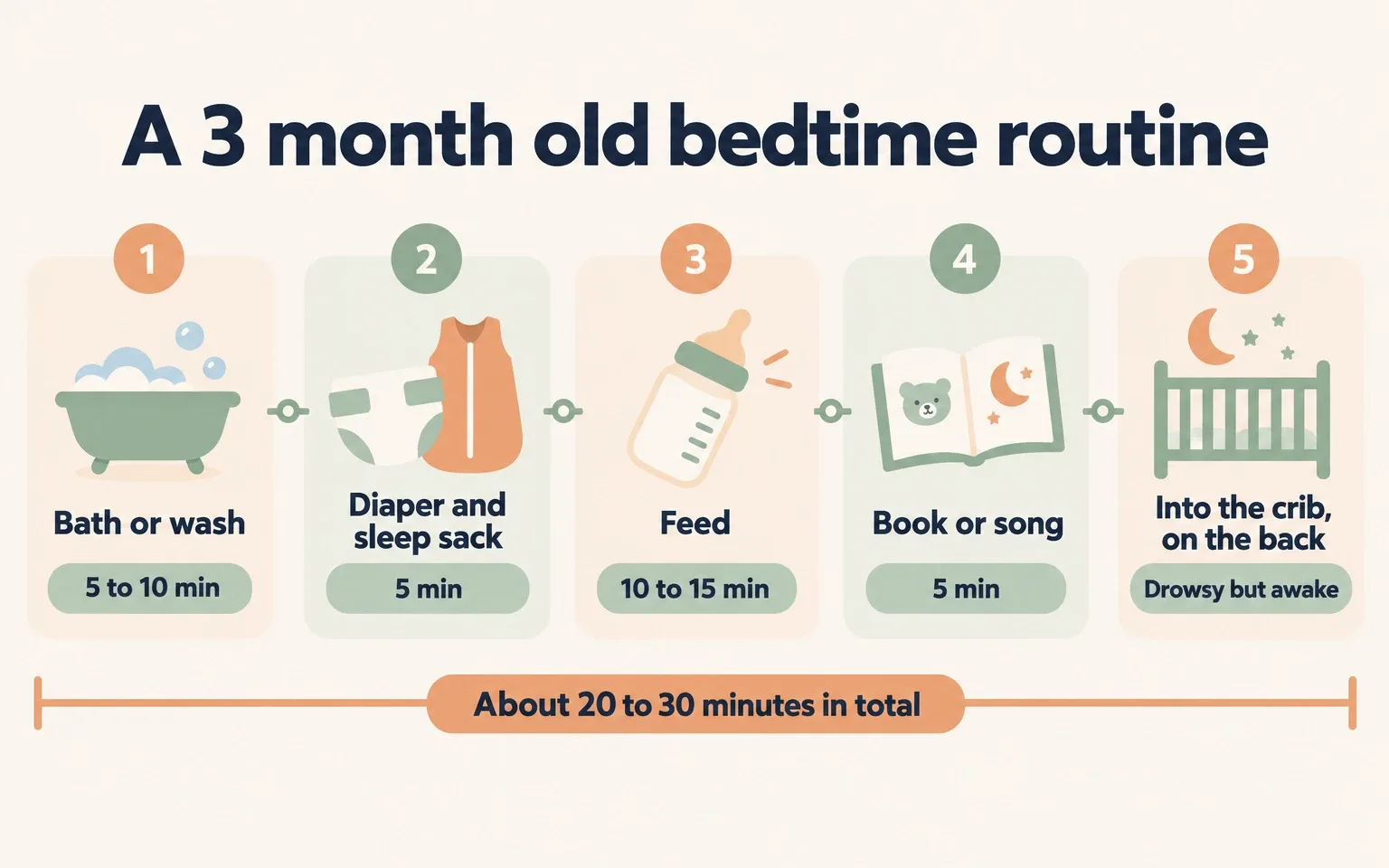
| Step | Time | Why it is there |
|---|---|---|
| Bath or warm wipe down | 5 to 10 min | Marks the switch from day to night |
| Diaper, pajamas, sleep sack | 5 min | Same clothes, same order, every night |
| Feed in a dim room | 10 to 15 min | A full tummy before the longest stretch |
| One book or the same song | 5 min | The closing cue your baby learns to expect |
| Into the crib, on the back | 1 to 2 min | Drowsy but awake, in a bare crib |
Nothing on this list is magic. You can swap the bath for a warm washcloth, the book for a song, the rocking chair for a slow walk around the room. What should not change is the order. At 3 months your baby is starting to recognize patterns, and the pattern is the whole point.
How to do it, step by step
How to do a bedtime routine for a 3 month old
- Start from the last nap
Note when your baby woke from the last nap of the day. Bedtime falls at the end of the last wake window, so that wake is your starting point.
- Begin about 30 minutes before bedtime
For a 7:10 pm bedtime, start around 6:40 pm. Starting when your baby is already fussing leaves you calming a tired baby instead of winding down a calm one.
- Bath or wipe down, then get dressed for bed
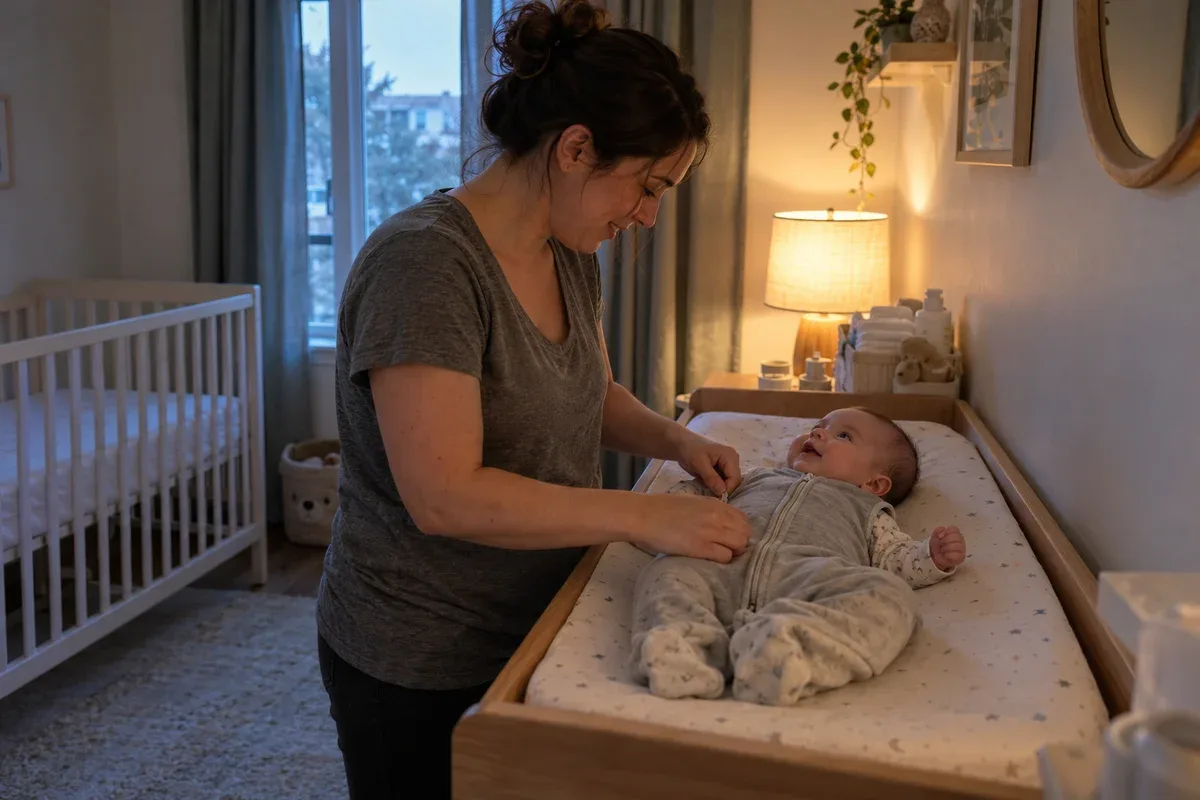
A short bath or a warm wipe of the face, hands and diaper area, then a fresh diaper, pajamas and the sleep sack, in the same order each time.
- Feed in a dim, quiet room
Lower the lights and the talking. Feed as your baby needs; a feed that runs long is fine, it simply comes off the end of the window.
- Close with the same cue
One short book or the same song, at the same point every night. This is the step that tells your baby what comes next.
- Lay your baby down on their back, drowsy but awake
Lower them into a bare crib or bassinet while their eyes are still opening and closing. If they need more help settling, that is normal at this age.
Should a 3 month old have a bath every night?
No. A bath is a nice signal, but a 3 month old does not need one every night, and many families do two or three a week. On the other nights a warm washcloth does the same job in the routine: it marks the change from day to night.

What matters is that the rest of the routine stays the same either way. A bath night and a quick night should share every step after the wash.
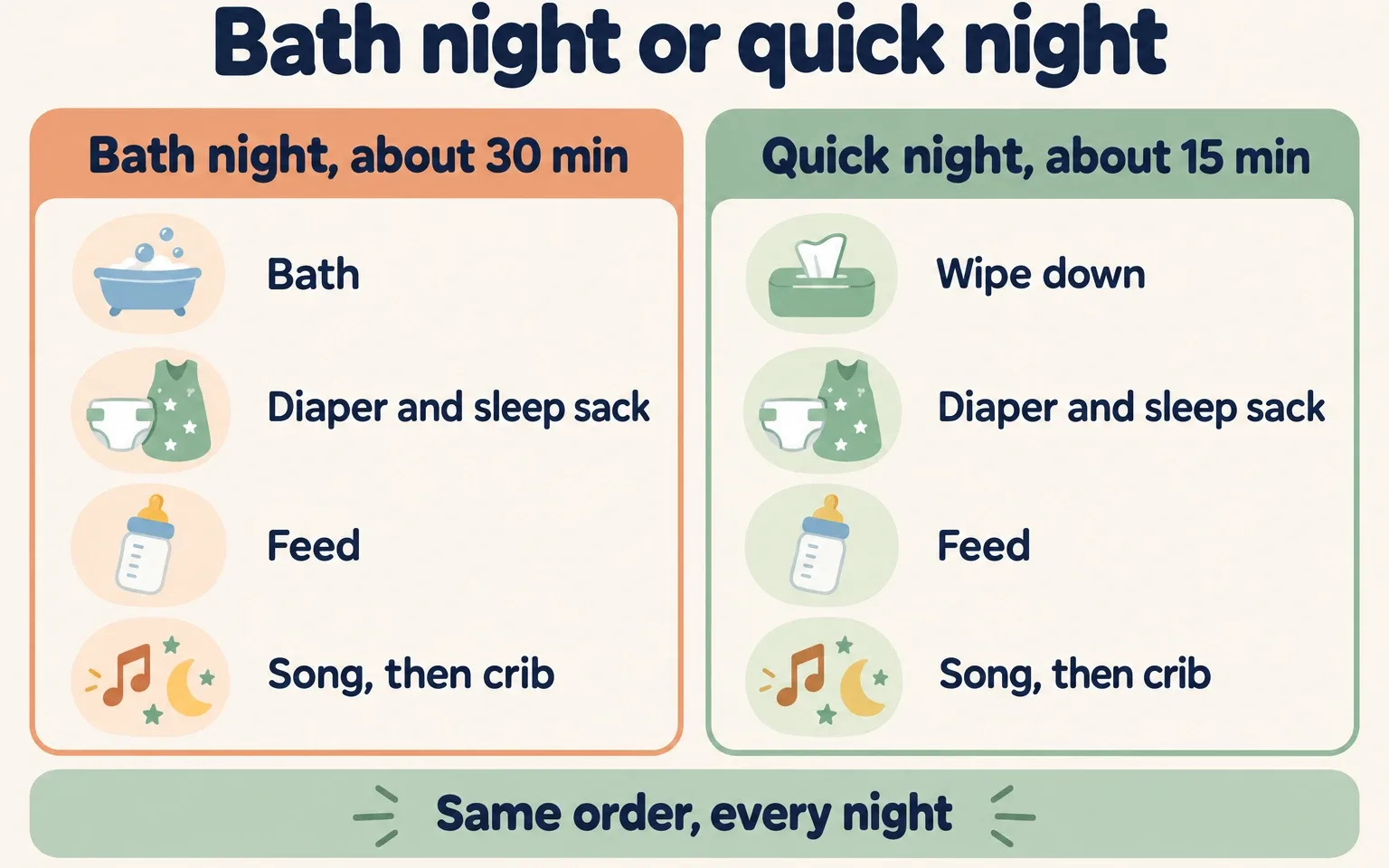
| Bath night | Quick night | |
|---|---|---|
| Length | About 30 min | About 15 min |
| Step 1 | Bath | Warm wipe down |
| Step 2 | Diaper and sleep sack | Diaper and sleep sack |
| Step 3 | Feed | Feed |
| Step 4 | Song or book, then crib | Song or book, then crib |
| Best for | Calm evenings, both parents home | Late naps, busy nights, travel |
The quick version is the one to practice. It is the version that survives a late nap, a visit, a hotel room or a night when one parent is alone with the baby.
What time should a 3 month old go to bed?
A 3 month old goes to bed at the end of the last wake window, counted from when the last nap ended. From a 7:00 am wake with four naps of about 45 minutes, the calculator puts bedtime at 7:10 pm, after a last window of 2 hr 20 min.
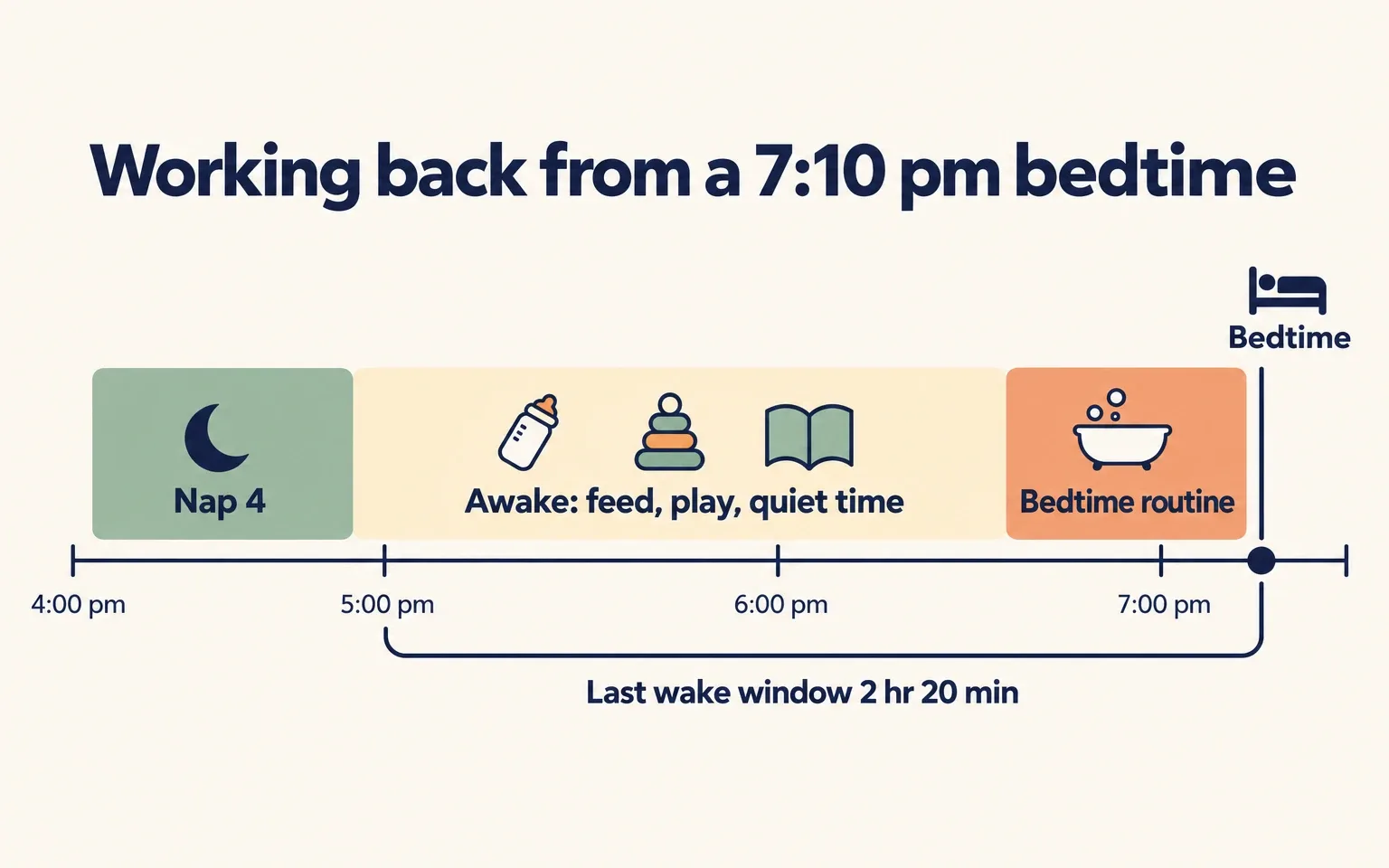
| If the last nap ends at | Start the routine around | Bedtime around |
|---|---|---|
| 4:15 pm | 6:05 pm | 6:35 pm |
| 4:50 pm | 6:40 pm | 7:10 pm |
| 5:30 pm | 7:20 pm | 7:50 pm |
These rows use the same 2 hr 20 min last window as the sample day. Your baby may need less after a short or skipped nap, so watch for early sleepy cues and start the routine sooner when you see them. The 3 month old wake windows guide has the full sample day and what to do when naps run short.
7 pm is a perfectly good bedtime if it fits the last wake window. If it does not, move bedtime, not the window.
Where does the feed go in the routine?
At 3 months, the feed usually goes in the middle of the routine, after the bath and pajamas and before the book or song. That way your baby goes into the crib with a full tummy but still has one short step between the feed and sleep.
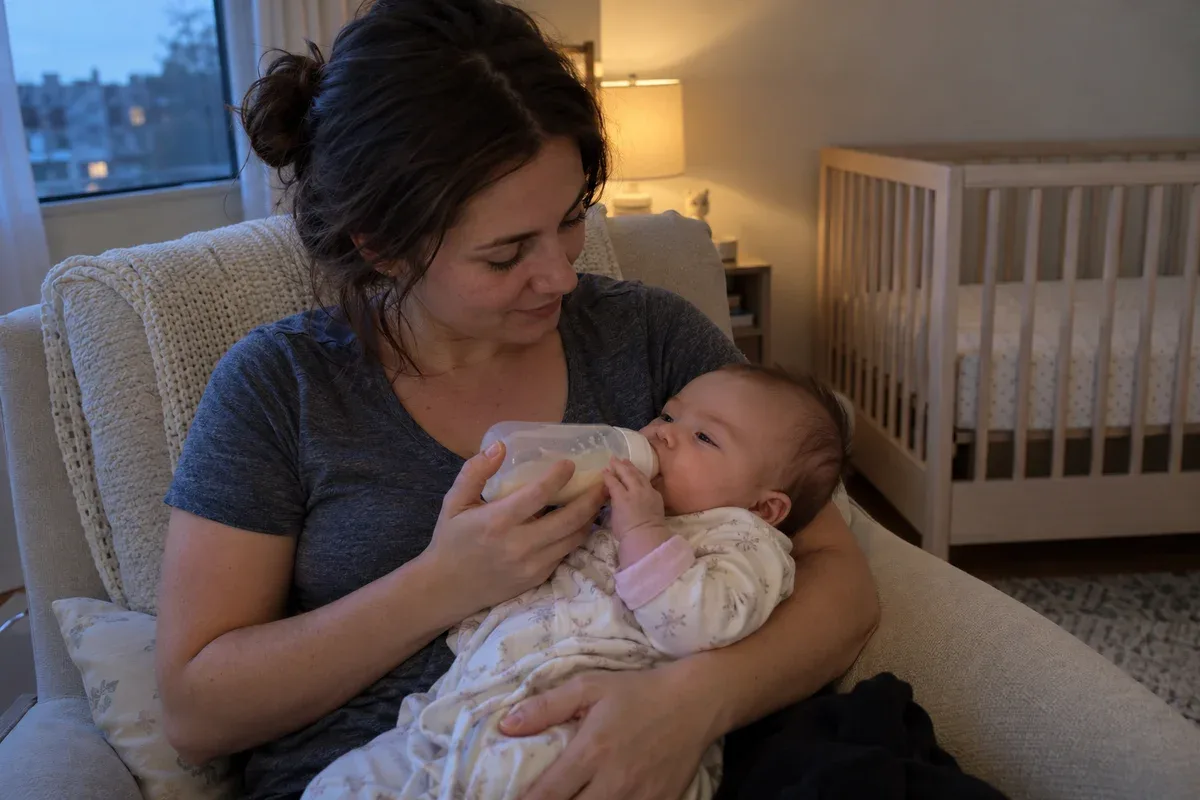
If your baby falls asleep during the feed most nights, that is common at this age and not something you have done wrong. You can keep the order as it is and lay them down anyway, or slide the feed a little earlier so it is not the very last thing. Neither is required. Feed whenever your baby shows hunger cues, at bedtime and overnight; a routine should never stand between a hungry baby and a feed. If you are thinking about a late extra feed before your own bedtime, read what a dream feed is and whether you need one first.
Stay awake while you feed, and if you feel yourself drifting off in the chair, put your baby down in the crib.
A closing cue your baby can learn
The closing cue is the last step before the crib, and at 3 months it should be short and the same every night: one book, one song, the same few words.
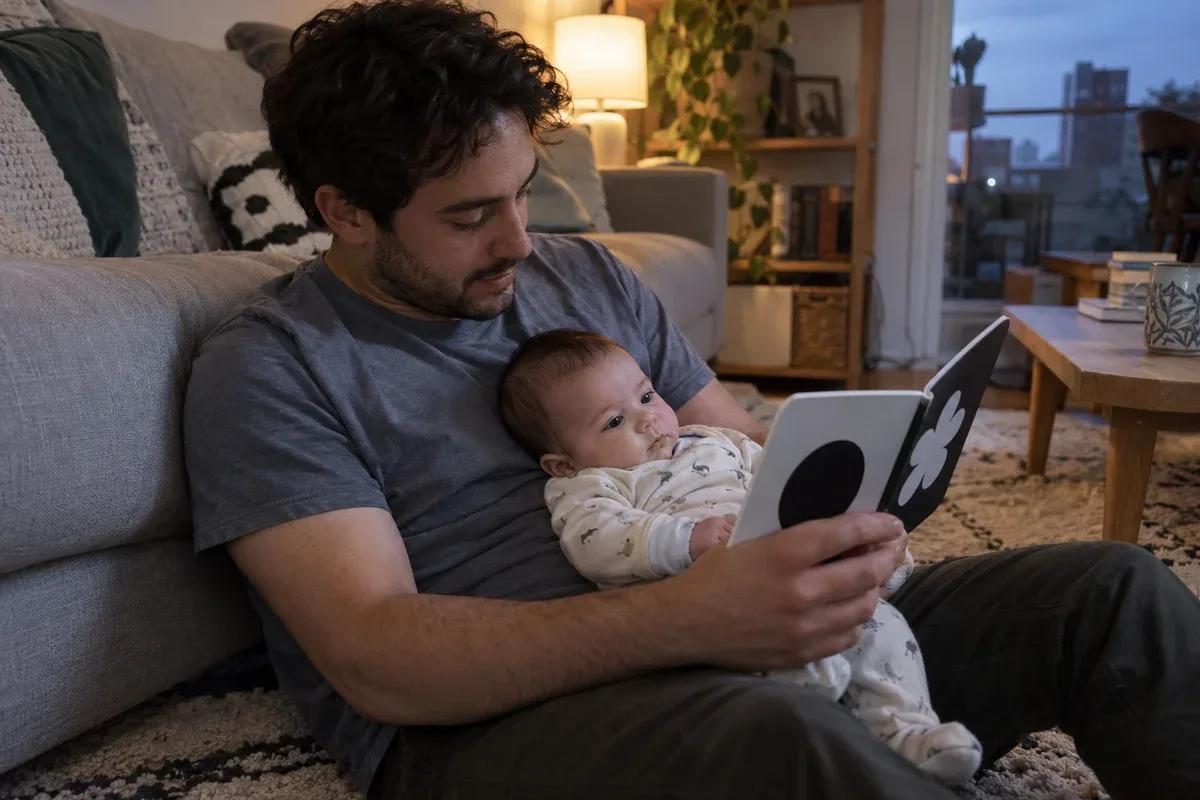
High contrast board books are easy to see at this age, but any short book works, and so does singing the same song in the same voice. Keep the lights low. This is not a learning moment; it is the step your baby will come to recognize as "next is sleep."
How do I put my 3 month old down drowsy but awake?
Lay your baby in the crib when they are calm and heavy eyed but not fully asleep, then give them a minute before stepping in to help. Some nights it works and some nights it does not, and both are normal at 3 months.
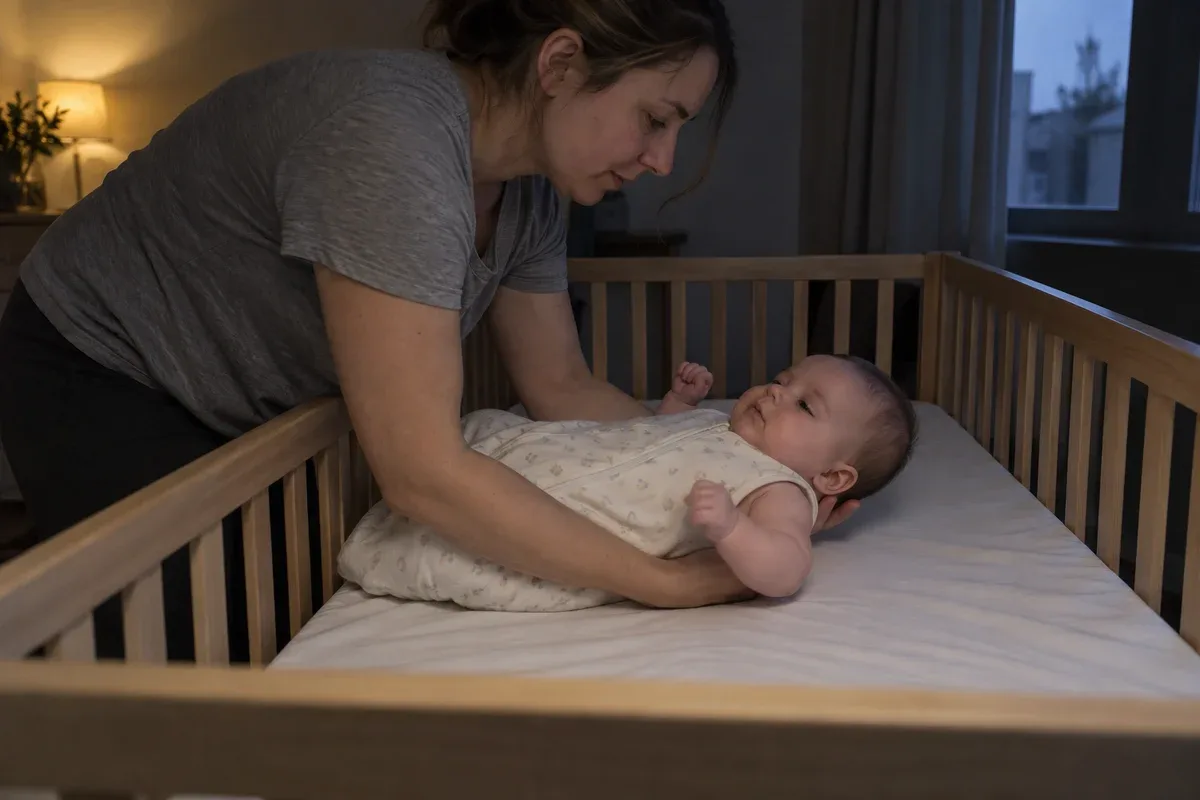
Drowsy but awake is practice, not a test. If your baby fusses, a hand on the tummy, a few shushes or picking them up and trying again are all fine. You are not undoing the routine by helping. If your baby is starting to roll, the swaddle has to go for every sleep; see when to stop swaddling for the signs and how to make the switch without changing the rest of the routine.
Common 3 month old bedtime routine mistakes
- Starting the routine when your baby is already crying. Start at the first early cue or about 30 minutes before bedtime, whichever comes first.
- Making the routine longer to get a sleepier baby. A longer routine can push past the wake window. Keep it about 20 to 30 minutes.
- Changing the order every night. The order is the signal. Swap a bath for a wipe, but keep the sequence.
- Pushing bedtime later after a short last nap. A short nap usually calls for an earlier bedtime, not a later one.
- Adding things to the crib to help settling. Loveys, pillows, blankets and positioners stay out. The crib stays bare.
Why a routine stops working (and what to do instead)
The routine itself rarely breaks. What changes is the timing around it. A 3 month old's naps vary from day to day, so the last nap ends at a different time, and a fixed 7:00 pm bedtime can land too early one night and too late the next. Doing that sum at the end of a long day is hard.
The free calculator above works it out from today's real wake and nap times, including the last window before bed. A nap plan builds on that and adjusts bedtime as your baby's naps change week to week.
How do I keep bedtime safe at 3 months?
Keep bedtime safe the same way as every nap: on the back, alone, in a crib or bassinet with a firm, flat mattress and a fitted sheet only, in your room but not your bed.
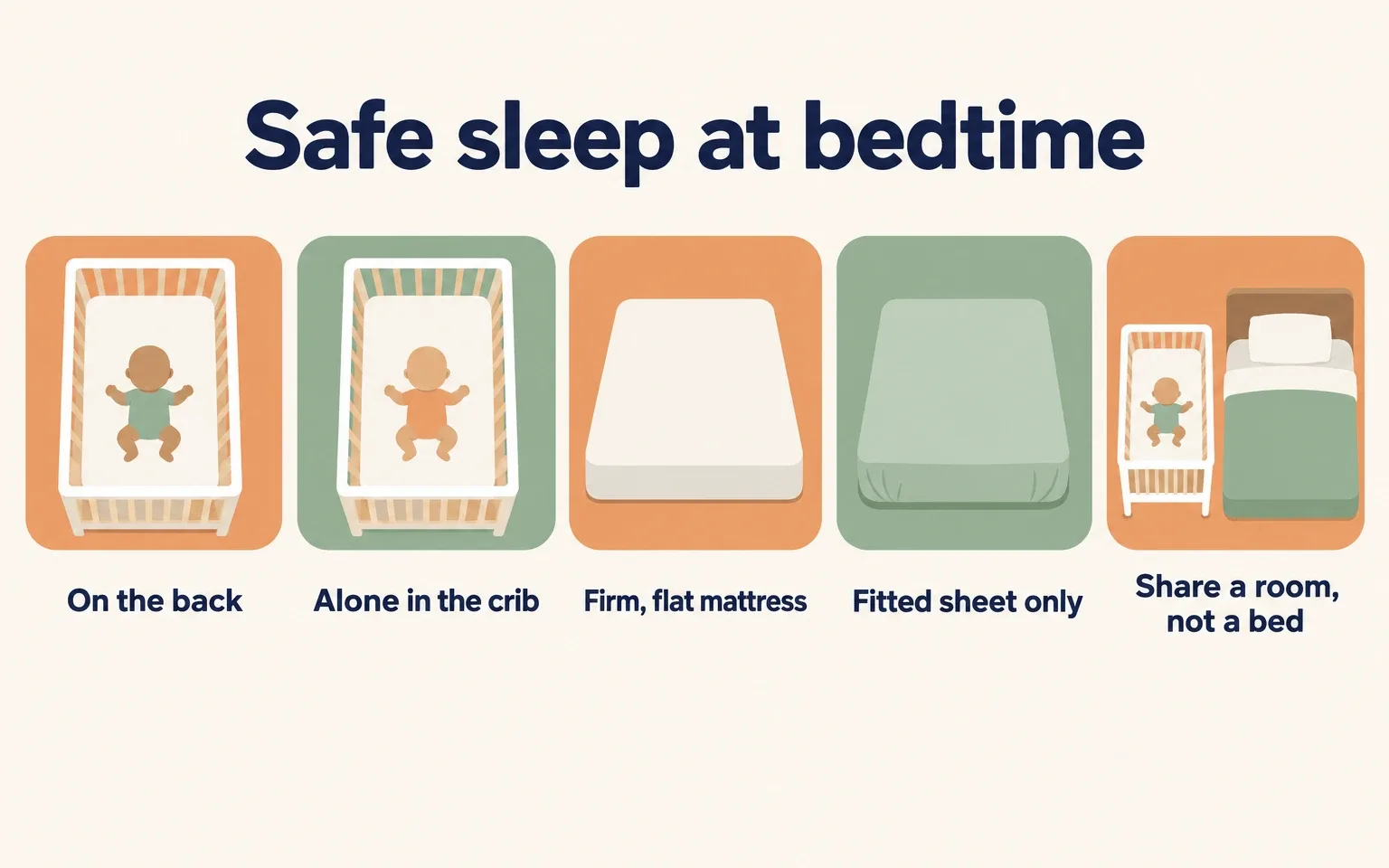
The AAP safe sleep guidance comes down to these rules:
- Always place your baby on their back to sleep, for naps and nights.
- Alone: nothing in the crib, no pillows, blankets, bumpers or toys.
- In a crib or bassinet with a firm, flat mattress and a fitted sheet.
- Share a room, not a bed.
A wearable sleep sack keeps your baby warm without a loose blanket. For fever, pauses in breathing, blue or gray lips, difficulty waking, or unusual sleepiness with poor feeding, call your pediatrician, or emergency services if it feels urgent.
A guide, not medical advice.
A bedtime routine for a 3 month old is short, calm and the same every night: wash, diaper and sleep sack, feed, one song or book, then on the back in a bare crib. The habit that matters most is timing, so start about 30 minutes before the last wake window ends. Put today's wake and nap times into the calculator above to find tonight's bedtime, or get a nap plan that moves it for you as the naps change.
Frequently asked questions
At the end of the last wake window, counted from the end of the last nap. From a 7:00 am wake with four naps, that is around 7:10 pm, but a late or short last nap moves it.
Yes, if it fits. A 7 pm bedtime works when the last nap ended a couple of hours earlier. If the last nap ended late in the afternoon, a later bedtime may fit better, and after a short or skipped nap an earlier one often does.
About 20 to 30 minutes is enough. A short routine done the same way every night teaches the pattern better than a long one that changes.
There is no set number, and many 3 month olds still wake to feed overnight. Feed when your baby shows hunger cues, and ask your pediatrician if you are unsure whether your baby is getting enough.
A realistic day has about four naps, wake windows of 1 hr 15 min to 2 hr 30 min, and a bedtime set by the last nap. From a 7:00 am wake that often means a bedtime around 7 pm, with plenty of variation from day to day.
No. Two or three baths a week is common, and a warm wipe down can stand in on the other nights. Keep the rest of the routine the same either way.
Wake windows for this age: 3 month old wake windows and nap times
Share article
About the author
Founder and editor
Alex Novak founded Napbird, builds the wake window calculator and edits every guide against the pediatric sources cited on each page. Alex is not a doctor or a sleep consultant, so Napbird is a guide, not medical advice.
More baby sleep guides

Night sleep · 9 min
Dream Feed: What It Is and Whether Your Routine Needs It
A dream feed is optional, not a promise of longer sleep. Learn what it means, how to review your evening and why feeding cues come before the clock.
Newborn sleep · 11 min
Newborn Sleepy Cues: Early, Mid and Late Signs to Watch
Newborn sleepy cues start quiet: a stare, stiller limbs, turning away from the feed. Yawns and eye rubbing come next, crying and arching last. Here is what each cue means, what to do, and why the clock matters as much as the baby.
Newborn sleep · 9 min
When to Stop Swaddling: Signs Matter More Than Age
Stop swaddling at the first attempts to roll, not a birthday. Choose unrestricted sleep clothing and keep the familiar routine for naps and nights.
Wake windows & schedules · 10 min
10 Month Old Wake Windows: 3 to 6 Hours + Sample Day
10 month old wake windows widen to 3 to 6 hours, yet the sample two-nap day stays close to 3 hours per stretch. Here is how to use the wider range without overtiring a cruising baby, plus cues, a wind-down and safe sleep basics.

Wake windows & schedules · 10 min
11 Month Old Wake Windows: 3 to 6 Hours + 2 Nap Schedule
11 month old wake windows are 3 to 6 hours, usually with two naps. The last window before bed is the longest, so bedtime trouble often starts with when the afternoon nap ended. Sample day, cues, daycare tips and safe sleep inside.

Wake windows & schedules · 10 min
12 Month Old Wake Windows: 3 to 6 Hours + Nap Guide
12 month old wake windows are 3 to 6 hours, and most first birthdays still come with two naps. The total sleep guidance changes at one year; the nap count does not have to. A cue-led day, sleepy cues and signs of the slow move toward one nap.